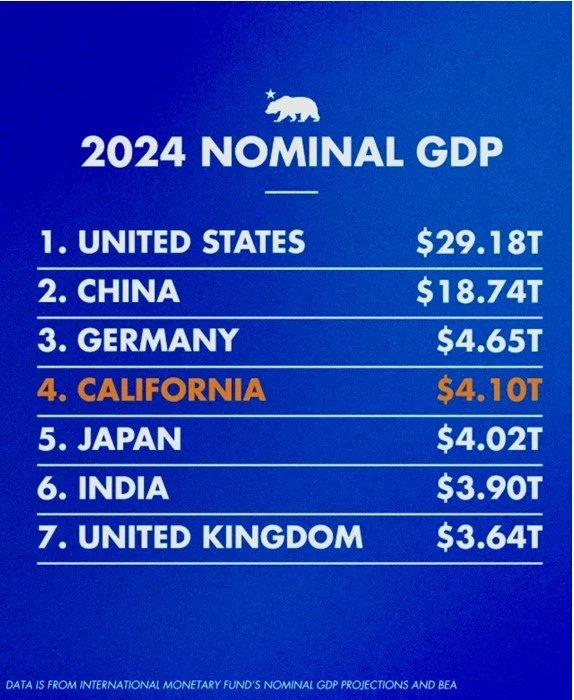
California’s Economy: Big on Paper, Struggling in Practice
California remains one of the largest economies in the world. But that headline obscures a more concerning reality: the state’s economy is no longer delivering broad-based growth, upward mobility, or stability for its residents.
A just published special report from the California Business Roundtable: “California’s Economic Performance Review 2025” lays bare the myth that the state is a thriving, 4th largest economy in the world, economic meca. It is not. Yes, California recently moved up to the fourth-largest economy globally—but that shift had more to do with currency dynamics abroad than meaningful gains at home. On the ground, households are experiencing something very different: rising costs, fewer opportunities, and an economy that increasingly feels out of reach. Poverty and reliance on government assistance programs remain significant challenges.
The data from 2025 tells a clear story: California’s recovery has stalled.
Job creation has flatlined, with employment barely returning to pre-pandemic levels. More than one million Californians remain unemployed, giving the state the highest unemployment rate in the nation. Even more concerning, the private sector—the core driver of long-term growth—is shrinking, with over 180,000 jobs lost in 2025 alone.
Where growth is occurring, it is increasingly concentrated in healthcare and government jobs. Most other sectors—including finance, manufacturing, logistics, and tourism—have remained flat over the past 18–24 months. These roles matter, but they are not a substitute for a healthy, expanding private economy that drives innovation, investment, and wage growth.
At the same time, the economy is becoming more uneven. A handful of high-performing sectors—particularly technology—continue to generate strong GDP numbers, while much of the rest of the state lags behind. In practical terms, large parts of California are being left behind.
Layered on top of this is the state’s cost structure. Housing, energy, and taxes remain among the highest in the nation. California also has some of the highest gasoline and electricity costs, driven in part by stringent environmental regulations. Two major oil refiners have exited the state, and no new refinery has been built in over 50 years. These pressures are eroding real incomes and pushing workers and employers to look elsewhere, resulting in steady outmigration of talent and capital.
The state’s fiscal outlook adds another layer of concern. Revenues are increasingly dependent on a narrow group of high-income taxpayers, while spending continues to outpace growth. Proposals such as the SEIU-backed wealth tax on unrealized capital gains are also impacting high-income Californians. Outmigration among these taxpayers is accelerating—and with it goes a significant share of the state’s income tax base. These are not short-term fluctuations; they point to deeper structural challenges.
The path forward depends on restoring private sector job growth, improving affordability, and reestablishing California as a competitive place to do business. Key indicators to watch include job creation, migration patterns, consumer spending, and business formation.
California still has extraordinary advantages—talent, innovation, and global reach. But those strengths are no longer enough on their own. Without meaningful course correction, the state risks a prolonged period of economic stagnation.
For policymakers, the message is straightforward: the warning signs are already here. The question is whether the state will act on them.