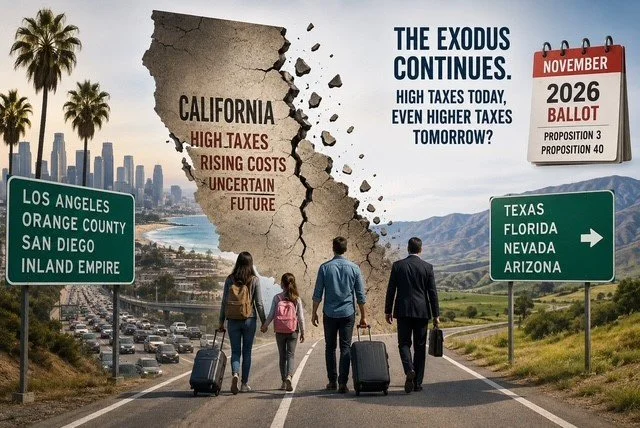
California’s Population Warning: Will Higher Taxes Push More Residents and Investment Out?
California has long been willing to test the limits of how much it can tax its most successful residents and businesses. This November, voters may find out whether the state is approaching a tipping point.
New migration data highlighted by Fox News show significant numbers of taxpayers continuing to leave some of Southern California’s largest counties. Los Angeles County recorded a net loss of 17,496 tax filers to other states, taking nearly $1.9 billion in income with them. Orange County lost a net 11,618 filers, San Diego County 9,401, Riverside County 8,968 and San Bernardino County 8,462.
California’s population picture is more complicated than simply saying the state is shrinking. Births and international immigration can offset residents moving elsewhere, and parts of California continue to grow. Riverside County, for example, remains a growth area. But the underlying domestic migration trend is troubling: according to the California Department of Finance, California experienced a net domestic migration loss of approximately 216,000 people during 2024–25. California has experienced negative net domestic migration for more than two decades. (https://dof.ca.gov/forecasting/demographics/estimates/E-6/?utm_source=chatgpt.com)
The latest state estimates provide another warning sign. Between January 2025 and January 2026, Los Angeles County’s population declined 0.6% and Orange County’s declined 0.4%. San Diego and San Bernardino counties posted only 0.1% growth, while Riverside County grew 0.4%. (https://dof.ca.gov/media/docs/forecasting/demographics/estimates/e-1_2026_press_release.Pdf?utm_source=chatgpt.com)
People leave California for many reasons. Housing costs, employment opportunities, family considerations and quality of life all play a role. But California policymakers cannot ignore another factor: the cost of living and doing business in a state that already imposes some of the nation’s highest taxes.
And now voters are being asked to go further.
On the November 3 ballot, Proposition 3 would make permanent California’s existing higher income-tax rates on high earners, which are currently scheduled to expire in 2031. State officials estimate those rates generate between $5 billion and $15 billion annually. (https://www.sos.ca.gov/elections/ballot-measures/qualified-ballot-measures?os=wtmbTQtAJk9ya&utm_source=chatgpt.com)
Even more consequential is Proposition 40, which would impose a one-time tax equal to 5% of the wealth of California billionaires. The tax would apply to covered assets including businesses, securities, intellectual property, art and collectibles. (https://www.sos.ca.gov/administration/news-releases-and-advisories/2026-news-releases-and-advisories/california-secretary-state-shirley-n-weber-phd-certifies-measures-november-3-2026-general-election-ballot?utm_source=chatgpt.com)
Supporters argue that Proposition 40 could raise tens of billions of dollars for healthcare, education and food assistance. Those are important public priorities, and the appeal of asking billionaires to pay more is easy to understand.
But there is another side to the equation that California cannot afford to dismiss: taxpayers can move. Capital can move. Businesses can move. And future investment can choose never to come here in the first place.
The state’s own nonpartisan Legislative Analyst acknowledges the risk. Its analysis of Proposition 40 says some billionaires may respond by leaving California and estimates that behavioral changes could reduce ongoing state income-tax revenues by less than $1 billion annually. (https://lao.ca.gov/BallotAnalysis/Proposition?number=40&year=2026&utm_source=chatgpt.com)
Investor and entrepreneur Mark Cuban recently put the concern more starkly, warning that if the billionaire tax passes, he would encourage multibillion-dollar startups in which he invests to move out of California. His argument isn’t simply about protecting billionaires. It is about where entrepreneurs decide to build companies, where venture capital is deployed and where the jobs created by those investments ultimately reside. (https://www.foxnews.com/politics/only-map-need-see-californias-billionaire-tax-fight-heats)
Even Governor Gavin Newsom opposes Proposition 40, as does Democratic gubernatorial candidate Xavier Becerra. Their opposition reflects an uncomfortable reality for California: at some point, continually increasing taxes on a relatively small group of highly mobile taxpayers can become counterproductive. (https://calmatters.org/politics/2026/08/billionaire-tax-california-democrats-split/?utm_source=chatgpt.com)
What will it take to make California a place where more people and businesses want to stay?
The November election could go a long way toward answering it.